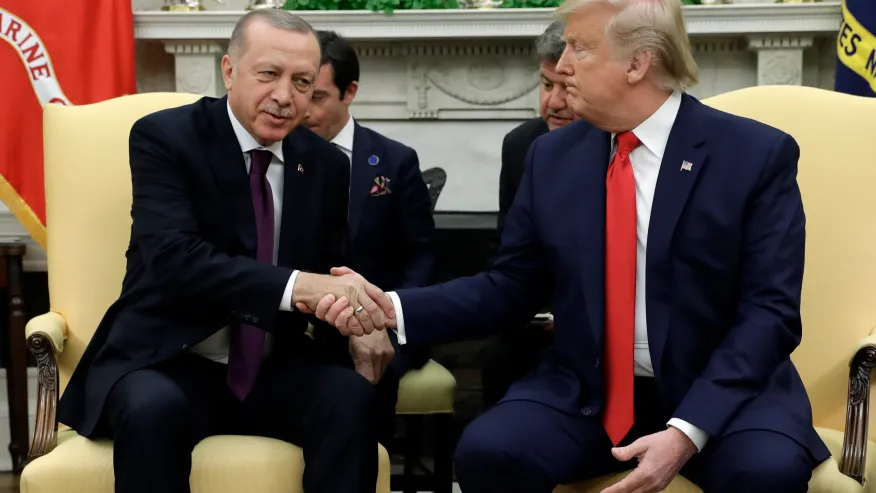
Recep Tayyip Erdoğan’s leadership has long been controversial, marked by sharp foreign policy reversals, increasing authoritarianism, an unresolved economic crisis, democratic and legal backsliding, and social polarization. Yet one of the most perplexing questions of modern geopolitics remains: Why do Western powers, especially the United States, the European Union and the United Kingdom, continue to support Erdogan, either directly or through strategic silence, despite his well-documented violations of democracy and human rights?
The answer lies not in moral consistency but in cold, transactional realpolitik. Erdogan offers the West a unique combination of control, utility and plausible deniability, a mix that makes him not only bearable, but in many ways highly desirable as a partner.
Erdoğan is a Powerful Local Actor
First of all, Erdogan is powerful. In a region where political stability is rare, Erdoğan has shown an extraordinary ability to hold on to power for more than two decades. He can be called a master of domestic politics, with a track record of mobilizing mass support, suppressing dissent, manipulating institutions and defeating opposition forces.
He regularly changes allies, redefines narratives and exploits national crises to consolidate power. This makes it not only resilient but also predictable in its methods. For Western actors, especially those who prioritize stability over democracy, Erdoğan’s strength and resilience offer an attractive alternative to the chaos affecting many neighboring states in the region.
Always open to negotiation
Despite his fiery Islamist and anti-Western rhetoric, Erdoğan is one of the most pragmatic and functional leaders in the region. His ideology rarely hinders his capacity to negotiate. On the contrary, he is willing to compromise on almost any issue, be it NATO defense policy, refugee management, energy deals or military operations in Syria, as long as his power and interests are protected.
For Western powers, this flexibility is invaluable. A democratic leader can be driven by domestic public opinion, party dynamics or parliamentary constraints. Erdoğan, on the contrary, acts as a central decision-maker, which greatly facilitates high-stakes diplomacy and behind-the-scenes negotiations.
Provides a Suitable Cover
Erdogan’s public image as an Islamist, anti-Zionist leader has earned him wide popularity in the Muslim world, especially among conservative and populist voters. But this image is often in sharp contrast to his policies.
For example, while pretending to be a defender of Palestine, Erdoğan also maintains strong economic and political ties with Israel. For more than two decades, Turkey has been among Israel’s top five trading partners in the Islamic world, with annual trade volumes exceeding five billion dollars. Turkish companies invest in Israel and Israeli firms make huge profits in Turkey. Even the raw materials for Israel’s defense industry are quietly sourced from Turkish suppliers. More than 50% of its oil consumption comes from Azerbaijan and is transported through Turkey.
This duality or cover gives the West a unique advantage: Erdoğan is able to achieve results without mobilizing anti-Western sentiments at home because his public image hides the essence of the cooperation.
Controlling the Conservative Base
One of Erdoğan’s most effective strategies is to maintain his grip on Turkey’s conservative and Islamist segments. He channels their anger and frustrations through controlled media, religious symbolism and polarizing rhetoric. His anti-Western and anti-Israel rhetoric feeds the loyalty of his base, even if his actual policies often serve Western interests. This gives Erdogan a unique ability to keep both nationalist and Islamist factions within Turkey in check.
Helping Manage Europe’s Migration Crisis
One of Erdoğan’s most strategically valuable roles is controlling migration flows to Europe. Turkey hosts millions of refugees and migrants from war and conflict zones in the Middle East, Africa and Asia. By preventing these people from reaching Europe’s borders, Erdogan has effectively outsourced one of the EU’s most pressing problems.
For a relatively modest financial package – measured in billions of dollars, but still far less than the cost of managing a continental migration crisis – Erdogan is providing something that no other leader in the region has: a human buffer zone. This deal has earned him the unofficial title of “Europe’s man in Turkey”. Erdoğan openly accuses Germany and France of hypocrisy in the migrant crisis, while providing vital support for their internal stability. The EU has tried, but failed, to replicate the human buffer zone created in Turkey in Egypt, Albania and Algeria.
Providing Strategic Services in the Middle East and Ukraine
Erdoğan’s value to Western powers extends beyond Turkey’s borders. He plays a key role in Syria, Libya and Ukraine, sometimes acting in line with NATO objectives, sometimes independently, but always making his involvement felt. His role in brokering grain exports from Ukraine and his mediation between Russia and NATO underline how indispensable he is in certain theaters.
Meanwhile, his rhetoric continues to portray him as a Muslim leader standing up to the West, giving him protection at home even as he pursues foreign policies that quietly support Western goals. This allows the West to conduct difficult or controversial operations with plausible deniability.
Erdogan is the leader Trump is looking for
During his first term, US President Donald Trump saw Erdogan as the ideal leader to pursue a Middle East policy based on strategic outsourcing. Trump saw that Erdogan was willing to fulfill almost any US request as long as his own interests were protected. In this context, during Trump’s second presidential term, Erdogan seems to have been given a strategic role to act as Washington’s regional subcontractor, especially on Syria, Iran and Israel.
But Trump wants to keep Erdogan under tight control. Giving him too much too fast would risk reducing US influence. Therefore, the relationship seems to be built on transactional control, a web of dynamics that many actors in the West continue to maintain.
The Age-old Western Agenda to Kick Turkey out of Europe
Perhaps the most overlooked reason for Western support for Erdoğan is ideological and civilizational. There is a strong current in European politics that sees Turkey as inherently “non-European”. This view of Europe as a Judeo-Christian, Greco-Roman cultural bloc has long resisted Turkey’s integration. Even at the peak of Turkey’s EU accession efforts in the early 2000s, these groups tried to derail the process, fearing that Turkey’s EU membership would weaken Europe’s cultural identity.
In this sense, Erdoğan has been an unlikely ally for those who want to keep Turkey away from Europe. Although he began his rule with strong EU aspirations, in 2010 he began to reorient Turkey towards a Middle Eastern and Islamic identity. This shift has been supported by the UK, which has been openly supportive of Erdogan, notably after the failed 2016 coup attempt, when London was quick to offer its support while other Western capitals hesitated.
By facilitating Turkey’s “Middle Easternization”, Erdoğan has fulfilled the long-term goals of this segment of Western politicians. The silence surrounding Turkey’s democratic backsliding, human rights violations and autocratic drift is not a lack of conscience, but a calculated decision based on strategic alignment.
Opposition’s Inadequacies
One of the overlooked reasons for the West’s continued support for Erdoğan lies not in his strengths but in the weaknesses of the opposition. From a Western perspective, Turkey’s opposition lacks the unity, competence and organizational strength to present a credible alternative. Fragmented and often reactive, the opposition seems trapped in political games designed by Erdoğan, unable to set its own agenda or articulate a coherent vision for the country.
Western powers value predictability and control. Erdogan’s fall could usher in a chaotic transition, potentially unleashing a long period of political revenge, legal turmoil and social fragmentation. Such instability poses a major risk to Europe, especially in a country that hosts millions of migrants. An unstable Turkey could send waves of refugees to the EU borders, an outcome that Western leaders are eager to avoid.
Leaders like Ekrem Imamoglu or Mansur Yavas may be acceptable to the West in theory, but for now they are not seen as strong enough to guarantee stability. Moreover, the West does not want to take action to replace Erdogan. It wants to see opposition leaders who can show strength by defeating him on their own terms, not those who rely on foreign support to come to power.
The opposition’s current stance is weakened by its hypocritical policies. Parties like the CHP once supported or at least tolerated many of the undemocratic practices they criticize. Their recent complaints seem to stem more from personal loss than principle. Meanwhile, the talented cadres who could rebuild Turkey’s institutions are either in exile or excluded from the political system.
In short, without unity, vision or strength, Turkey’s opposition cannot offer the West or the Turkish people an alternative to Erdogan.
Conclusion
Western support for Erdoğan is neither naive nor inconsistent. It is deeply pragmatic. In Erdogan, Western powers have found a leader strong enough to control his country, pragmatic enough to negotiate anything, and hypocritical enough to camouflage uncomfortable alliances. For the EU, the UK and the US, Erdoğan is not a perfect partner, but in many ways he is the most useful one they could hope for in a region marked by slippery ground and complexity. What this partnership will bring to the West in the long run remains to be seen. For now, however, the West does not oppose Erdoğan; it trusts him. And Erdoğan continues to play his part.