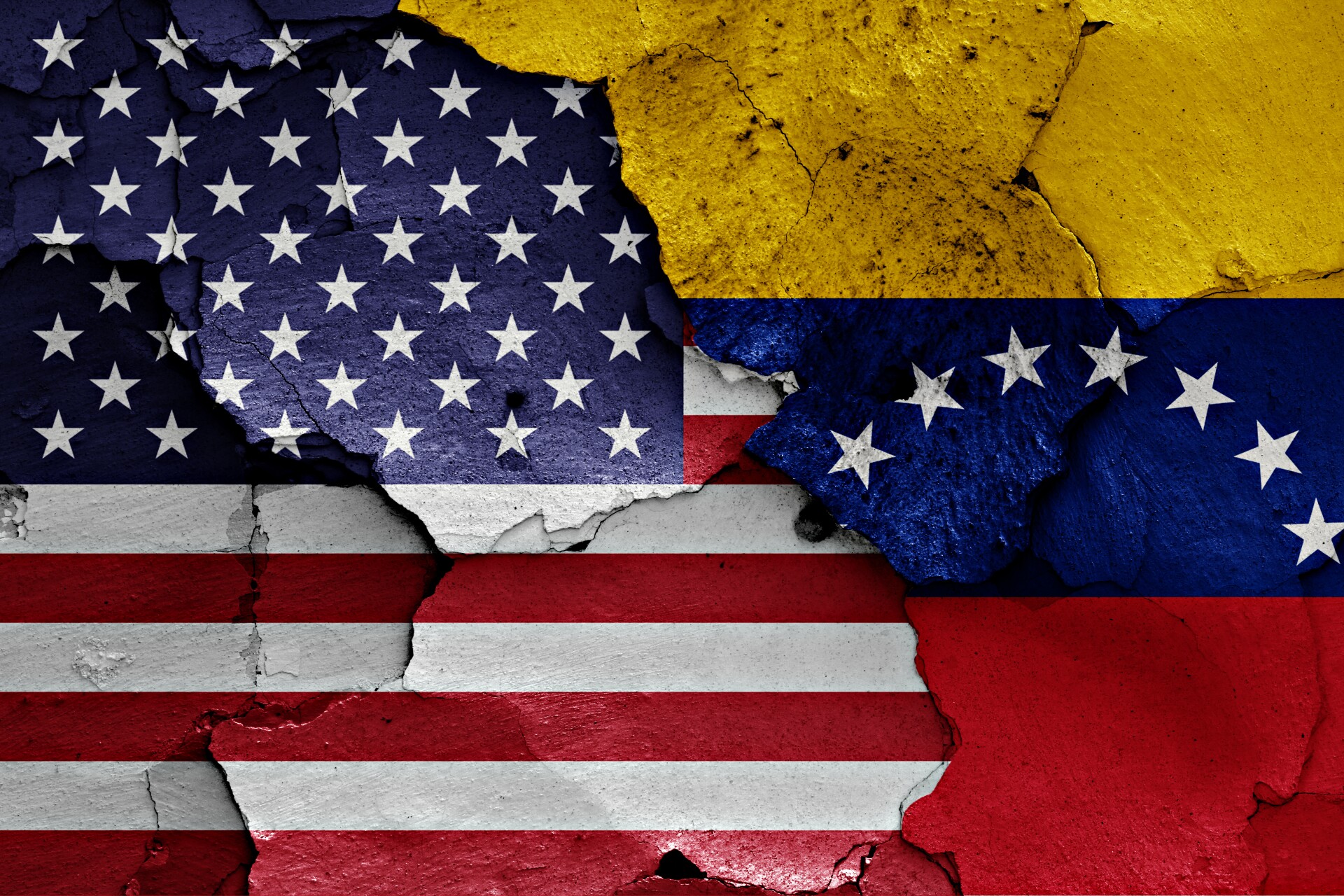
The military activity near Venezuela shows that the tensions between Washington and Caracas are no longer a mere diplomatic crisis, but a much deeper geopolitical rupture. Trump’s declaration of Venezuelan officials as “terrorists”, his call to declare the airspace “closed”, the docking of the world’s largest aircraft carrier in the Caribbean and the deployment of tens of thousands of troops in the region, from special forces to marines, go far beyond the narrative of an ordinary “drug operation”. In response, the Maduro administration has put hundreds of thousands of troops and militias on alert and is talking about a doctrine of “prolonged resistance”, while at the same time maintaining backdoor diplomacy with Washington. This two-sided picture plunges the region into a multidimensional crisis in which military threats, psychological pressure, diplomatic bargaining and great power rivalry are intertwined.
The US Narrative of “Narco-Terrorism”
Washington’s harsh criticism of Venezuela, especially in Trump’s second term, is based on two main factors: domestic politics and international legitimacy. Domestically, the criminalization of Venezuelan migrants, the claim that “Maduro is sending criminals to America” and the blaming of Latin America for the opioid crisis offer a strong security message to Trump’s base. In the international arena, the discourse of “narco-terrorism” creates a framework that resembles counter-terrorism operations, not classical inter-state military intervention. Thus, by redefining the Venezuelan state as a “cartel-state”, the US places its operations in a gray area in international law
The reality on the ground is incompatible with this narrative. According to experts, fentanyl production comes from chains linked to Mexico and China; Venezuela is neither the producer nor the main transit route. The “Cartel de los Soles” is not an organized structure, as the US claims, but a phrase that has been used for years to describe the corrupt relations of Venezuelan military officers. Nevertheless, by declaring Maduro its leader, Washington has criminalized the entire state system. This is more a strategic tool than an operational justification: Venezuela is no longer presented as “a government to be negotiated with”, but as “an illegal entity to be liquidated”.
Psychological Pressure and the Bluff-Shadow Diplomacy Cycle
One of the most critical points underlined by experts is that a significant part of the US threats against Maduro are psychological operations. Washington tried the same method during the Guaidó process in 2019: sudden statements, messages hinting at a coup, a high-level military build-up and an atmosphere of “we can attack at any moment”. The aim was to create a dissolution within the regime rather than to organize a military attack. Today’s model continues along the same lines.
The Trump administration is using its military presence around Venezuela not only to project power on the ground, but also to exert pressure on the regime elites by creating a constant sense of uncertainty. This atmosphere is creating fissures within the regime, loosening the loyalty of the security bureaucracy and raising concerns about the future among Maduro’s inner circle. In the past, Maduro has dismissed many of these threats as “bluffs” and has maintained power by keeping the military behind him. But the picture is different today: the military buildup is much larger, the political motivation within the US is higher, and Maduro’s 2024 elections pose a serious legitimacy challenge both internally and externally.
One of the most important developments at this point is the phone diplomacy between Trump and Maduro. These conversations show both that the US is using military pressure as leverage for negotiations and that Maduro is well aware of the risks he faces if he loses power. Maduro is known to be demanding immunity and control of the military, demonstrating that for the regime, relinquishing power is not just a political but an existential issue. In other words, no matter how great the threat on the ground, surrender is not an option for regime insiders. This makes Washington’s strategy of ratcheting up the pressure even tougher.
Maduro’s Strategy: Resistance and the Search for Legitimacy
Maduro’s government has survived more than a decade of crisis. During this time, it has experienced countless shocks, from economic collapse to blackouts, sanctions and coup attempts. The regime’s reflexes are therefore highly developed in using the external threat as a tool for internal political unity. Today, by framing the US threat as “the nation’s fight for survival”, it is both narrowing the space for the opposition and consolidating the military around an ideological sense of responsibility.
Maduro’s constant messages of peace, quoting John Lennon and calling for “peace, dialogue and harmony” may seem like a soft tone on the surface, but it is actually a diplomatic positioning strategy. In order to make Washington’s military moves look like a first strike, the rhetoric of peace becomes a means of generating international legitimacy. Simultaneously mobilizing the army on the ground, mobilizing militia forces and broadcasting messages of “prolonged resistance” on state television is a reflection of the regime’s effort to maintain its leadership profile.
Great Power Rivalry: The Return of the Neo-Monroe Doctrine
Today’s crisis makes it clear that the United States sees Venezuela not just as a “problematic neighbor” but as the most critical front in the Latin American leg of the great power competition. A Venezuela where China continues to invest billions of dollars in oil, Russia provides military technology and intelligence support, and Iran helps to circumvent US sanctions through refinery cooperation is not an acceptable picture for Washington.
Trump’s approach to Latin America in his second term has turned into a tough and unilateral version of the classic Monroe Doctrine. This new doctrine aims at purging the region of non-US influences, and the first step is Venezuela. For the fall of Caracas would undermine China’s influence in the region, limit Russia’s military reach and dismantle Iran’s economic networks in Latin America. In other words, Venezuela is not just a country for the United States; it stands at the intersection of global competition in the Western Hemisphere.
The Guyana Factor: The Silent Determinant of Energy Geopolitics
A key element in understanding the Venezuelan crisis is the rising energy power of Guyana (a country in South America). ExxonMobil’s production in its huge offshore oil fields is transforming Guyana into Latin America’s new energy star. Venezuela’s reassertion of its historical claims to Guyana’s Essequibo region is read by the United States not only as a regional security challenge, but also as a direct threat to the interests of American oil companies.
This picture suggests that energy is a much more decisive factor in Washington’s tough stance towards Venezuela than one might expect. In the eyes of the United States, Maduro’s claims represent not just an aggressive foreign policy, but a challenge to Guyana’s energy future.
US Military Options: Real Attack or Controlled Leverage?
While the US military presence in the region is massive, a full-scale ground invasion is considered unlikely for logistical, legal and political reasons. Trump’s base does not favor large-scale wars, Congressional authorization debates are fierce, most Latin American countries are openly opposed to an invasion, and the geography of Venezuela makes a prolonged operation extremely costly. Washington’s military options are therefore shaped around limited-scale, narrowly targeted operations.
Nevertheless, the military build-up looks serious, but it is an ideal lever for pressure and negotiation. According to experts, what we are seeing on the ground today is part of a controlled but high-intensity psychological war, rather than preparations for an invasion. Military readiness brings to the table not only the possibility of an attack but also the fear of regime unraveling.
Conclusion
What is happening in Venezuela today is not just a country’s domestic politics or a leader’s struggle for power; it is a multi-layered geopolitical fault line where internal security discourse, great power competition, energy geopolitics, criminal narratives and regime security overlap. US military power, rhetoric and diplomatic moves are clearly fueling the escalation, but the ultimate goal of this escalation is not invasion; it is to create regime disintegration, force Maduro to make concessions and break Venezuela’s external alliances.
Maduro is trying to maintain the balance with a strategy based on “survival”. He is mobilizing the army, using peace rhetoric in the international community, while simultaneously trying to maintain loyalty within the regime and maintaining invisible negotiations.
For this reason, Venezuela is now the scene not only of its own internal contradictions, but of a sharpening geopolitical showdown at the heart of the power order in the Western Hemisphere. The crisis is deep, the instruments are harsh and the outcome is still uncertain. But one thing is certain: Venezuela will remain one of the most critical issues of the coming months.
Image Source: Danielo/Shutterstock (via energyintel.com), Music: “Road To Kilcoo” by Audionautix