Discussions about the possibility of a large-scale Kurdish uprising inside Iran have become more visible in the public sphere with recent developments. However, when the political realities on the ground, the internal balances in Iraqi Kurdistan, the limited capacity of Kurdish movements and the institutional structure of the Iranian state are considered together, this scenario does not seem to be as strong a possibility in the short term as widely assumed.
Israel-Iran War and the Kurds
On the morning of February 28, 2026, the United States and Israel launched a coordinated air campaign. This operation included heavy bombardment of military and strategic infrastructure targets in Isfahan, Qom and several major cities, including the Iranian capital Tehran. The strikes killed Iran’s top religious and political leader, Ayatollah Ali Khamenei, and senior military and civilian officials in his circle. In the following days of the war, Iran retaliated regionally, particularly against US bases and Israeli settlements, and the conflict quickly escalated into a regional crisis.
The Middle East has witnessed many crises and conflicts in recent years, but the recent rapid escalation of tensions points to a period in which regional balances may be reshaped. In particular, the mutual military and political moves between Iran and the United States have made the already fragile regional security architecture even more vulnerable. In this process, Israel’s military operations against Iran and Iran’s response showed that the crisis is not limited to the two states.
In the early stages of the war, attacks on Iran’s military infrastructure and some of its strategic facilities demonstrated that tensions quickly escalated to a military dimension. In response to these attacks, Iran took steps to increase its regional deterrence and expanded its military mobilization. Thus, the conflict has turned into a geopolitical struggle that is not only limited to tactical operations but also affects the regional balance of power.
In the wake of these developments, a new debate has rapidly emerged in international media and political circles: The possibility of a large-scale Kurdish uprising inside Iran. Some commentators argue that the pressures of the war could create a political rupture in the Kurdish regions of western Iran, which could turn into a major internal uprising.
However, a careful analysis of the political realities, social dynamics and military balances on the ground shows that this scenario is based on very weak foundations. The emergence of a large-scale and sustainable Kurdish uprising in Iran seems unlikely due to both the regional balance of power and the internal structure of the Kurdish community.
Iraqi Kurdistan Iran’s Sphere of Influence
In order to understand the regional dimension of the Kurdish issue in Iran, it is first necessary to analyze the political structure in Iraqi Kurdistan. This is because a significant number of Kurdish political movements in Iran are directly or indirectly linked to this region.
In this context, the political structure around Sulaymaniyah is particularly striking. Sulaymaniyah is a center under the influence of political actors who have developed close relations with Iran for many years. According to many observers in the region, Iran has a strong presence here not only through diplomatic relations but also through economic and intelligence networks.
One of the allegations voiced from time to time in local circles is that the information of the people staying in hotels in Sulaymaniyah was soon in the hands of Iranian intelligence. Although the veracity of such allegations has not been conclusively proven, it shows the existence of a strong perception of the extent of Iran’s influence in the region.
The political leadership in Sulaymaniyah also supports this picture. The Patriotic Union of Kurdistan (PUK) leader Bafel Talabani’s close ties with Iran are a frequently emphasized element in regional politics. According to many analysts, it seems difficult for the Sulaymaniyah administration to undertake a strategic military move without Iran’s explicit or implicit approval.
Economic factors also reinforce this dependency. The Sulaymaniyah administration has been facing a serious financial crisis for a long time. Delays in the payment of public employees’ salaries often lead to protests. Under these circumstances, it is unlikely that an economically fragile administration would support a military initiative against Iran.
Erbil: A Center of Attraction for Economic Stability
In Iraqi Kurdistan, a different political and economic model from Sulaymaniyah has emerged in Erbil. In recent years, the Erbil administration has created a more institutionalized administrative structure and turned the region into an important trade and investment center.
Today, high unemployment rates in the Kurdish regions of western Iran have driven a significant number of Iranian Kurds to Erbil in search of economic opportunities. Therefore, Erbil has become a center of attraction not only for Iraqi Kurds but also for Iranian Kurds.
This raises an important question: Do the Kurds in Iran really want to participate in a risky military venture that could destabilize an order that offers them economic opportunities? According to many analysts in the region, this seems unlikely. Economic stability and migration opportunities are a much stronger motivation than calls for armed conflict.
The Depth of Iran-Iraq Ties
Relations between Iran and Iraq are strong not only at the diplomatic level but also in the fields of security and intelligence. It is frequently stated that Iran has an extensive intelligence network in Iraq.
Therefore, a large-scale attack on Iran is unlikely to be organized clandestinely with preparations in Iraqi border areas. Given modern intelligence systems and local networks, it seems extremely difficult for a military mobilization involving thousands of people to remain completely secret.
Frequently asked questions in this context include: Where are the armed groups allegedly attacking Iran concentrated, which border areas have they crossed, and is it clear exactly in which geographical areas the fighting is taking place? Many of these questions still lack clear answers.
Historical Memory and Regional Lessons
One of the important factors shaping the strategic decisions of political movements in the region is historical experience. Kurdish political movements have closely experienced the fragility of some political projects established with the support of foreign powers in the past.
For example, the short-lived Kurdish state established in northwestern Iran after World War II with the support of the Soviet Union lasted only about a year. When foreign support was withdrawn, this structure quickly collapsed.
This experience is an important lesson for many political actors in the region: political projects that are not based on strong local social foundations and are overly dependent on external forces may have limited sustainability.
The Limited Capacity of Kurdish Political Movements in Iran
The military capacity of Kurdish political movements operating in Iran is often overestimated. For example, the total number of fighters of PJAK, one of the organizations operating in Iran, is estimated to be around a few thousand.
Similarly, the military capacity of organizations such as the Kurdistan Democratic Party (Iran) is considered to be limited. It is believed that the total number of fighters of these organizations does not exceed a few thousand people.
These figures seem insufficient to launch a sustained insurgency in a large geographical area controlled by a modern state. Iran is a large state with a population of around 90 million and has extensive security institutions.
Internal Diversity of Kurdish Society
The perception that the Kurdish community in Iran constitutes a homogeneous political structure does not fully reflect the reality. There are both religious and political differences among Kurds. There are both Sunni and Shia Kurdish communities in Iran and there have been serious tensions between these groups in the past during some political crises.
Moreover, a significant portion of the Kurdish population in Iran is now urbanized. In modern urban life, tribal ties have weakened considerably and economic concerns have taken precedence over identity-based political mobilization. This makes the emergence of a large-scale social uprising even more difficult.
Mobilization Capacity of the Iranian State
Iran is a state with high institutional capacity not only in terms of population size but also in terms of crisis management capacity. The Besij, one of Iran’s paramilitary structures, constitutes a vast social network that can be rapidly mobilized in times of crisis.
In addition to Kurds, Azeris, Lurs and many other ethnic groups live in Iran. It is unrealistic to assume that these groups will remain completely passive in the event of an internal conflict. The Iranian state has the institutional capacity to mobilize these social networks in times of crisis, and this requires consideration of the state’s capacity to intervene.
Policy Implications
One of the main policy implications of this analysis is that assumptions that a large-scale Kurdish uprising in Iran will take place in the short term can be misleading for strategic planning. If regional policymakers rely on analyses that underestimate Iran’s internal dynamics and state capacity, this could lead to serious strategic mistakes.
Moreover, regional actors need to make more cautious assessments, taking into account that the ethnic and political balances in Iran are extremely complex. Over-reliance on the scenario of an internal uprising within Iran could lead external actors to misread the real balance of power in the region.
Therefore, international policymakers need to assess Iran not only in terms of its military capabilities, but also in terms of its social mobilization power, intelligence networks and regional spheres of influence. A more realistic strategic analysis should also consider the institutional resilience of the Iranian state while trying to understand its potential internal vulnerabilities.
Conclusion
As a result, a large-scale Kurdish uprising in Iran seems unlikely in the short term. Iran’s strong political and intelligence influence over Iraqi Kurdistan, the limited military capacity of Kurdish political movements, the religious and political differences within the Kurdish community, and the Iranian state’s large mobilization capability significantly limit this possibility.
Moreover, actors in the region have learned important lessons from past experiences. The fact that many political projects initiated with the support of foreign powers have collapsed in a short period of time makes social and political actors in the region more cautious about risky initiatives.
Therefore, claims of a major Kurdish uprising inside Iran in the short term should be evaluated not only in relation to developments on the ground, but also within the discursive framework created by geopolitical rivalry. Given the current balance of power in the Middle East, the emergence of such a movement in Iran requires not only external incentives but also much deeper social and political transformations.
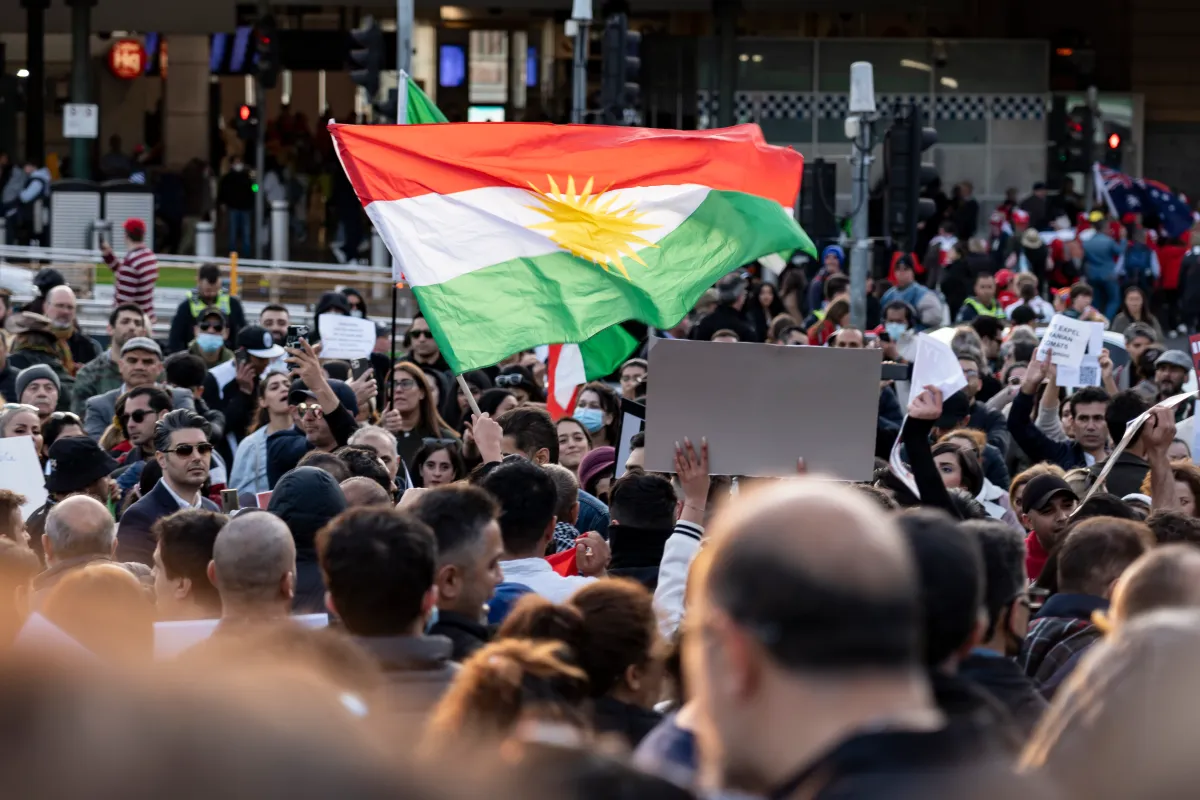
Image: Matt Hrkac / Wikimedia Commons (CC BY 2.0). Image courtesy of “The Kurdish Question Unanswered”