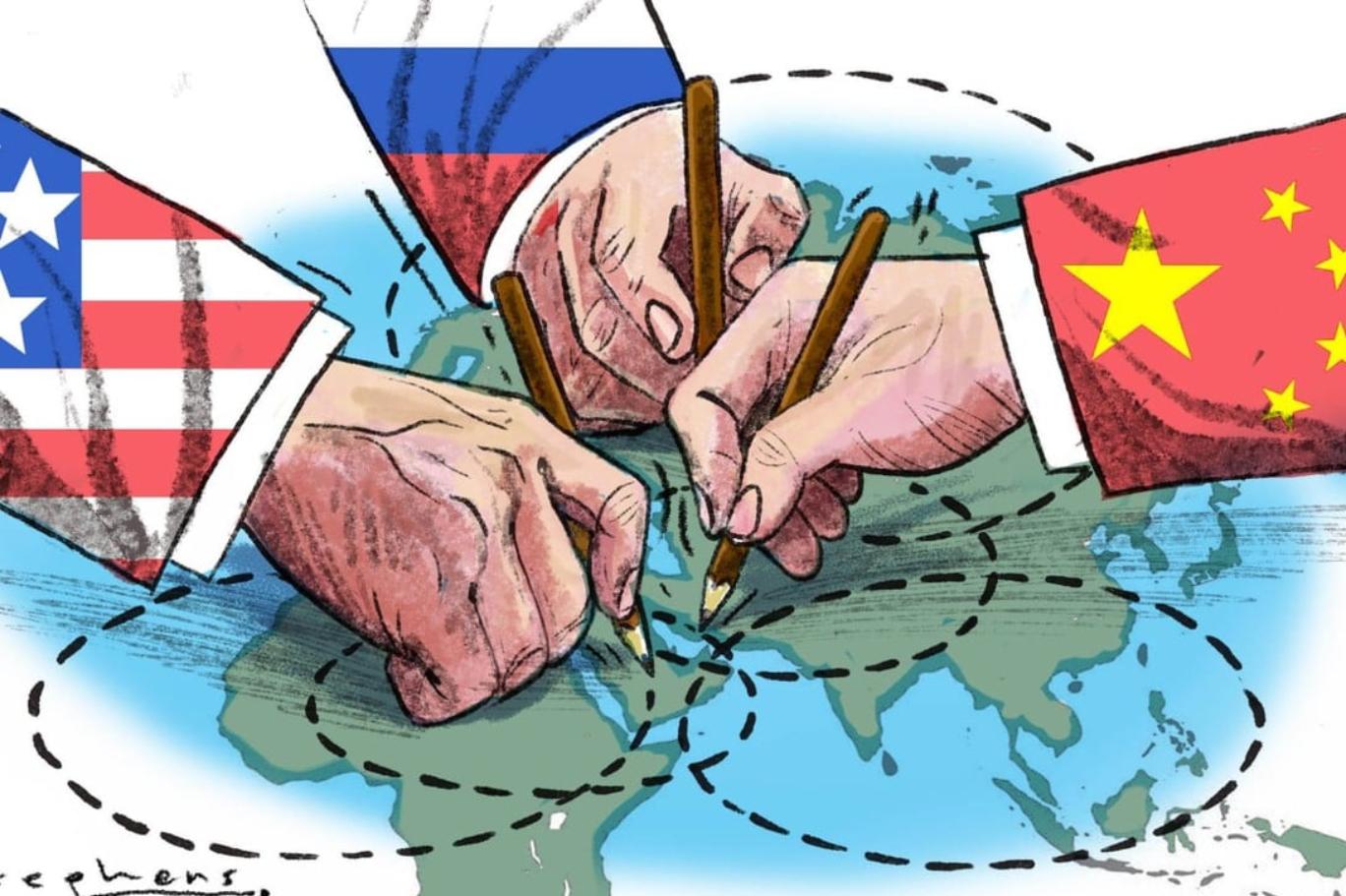
By 2025, Central Asia has become the “quiet center” of the geopolitical agenda: the fragility of global supply chains, critical minerals and energy security, geopolitical fragmentation accelerated by the Russia-Ukraine war, and China’s infrastructure-driven economic pull are bringing the region back into the spotlight. The Trump administration’s November 6 meeting with Central Asian leaders, which brought Washington’s C5+1 format to the White House showcase; Putin’s defensive but persistent pursuit of consolidation when he met with Central Asian leaders in Dushanbe last month; and Chinese President Xi Jinping’s move to institutionalize relations and strategic expansion across the region when he met with Central Asian leaders in Astana last June reveal three trends that belong to the same picture. The intersection cluster is embodied in the triad of “resources-corridors-regime security”. In this article, the objectives of each great power, the multi-vector maneuver space of the Central Asian states and Turkey’s approach to this alignment will be discussed.
USA: Market and Geoeconomic Bypass
Washington’s geoeconomic strategy is at the heart of its orientation towards Central Asia: it aims to bypass China’s processing monopoly in critical minerals, especially uranium, rare earth elements, copper-gold chains, and strategic dependencies on Russia. The formation of the C5+1 (Kazakhstan, Kyrgyzstan, Turkmenistan, Turkmenistan, Tajikistan, Uzbekistan + the United States) at the leaders’ level at the White House has moved this format from technical cooperation to the top of the strategic agenda. The agreements, ranging from Boeing orders to rare elements and mining partnerships, are interpreted by experts as “the US adopting a targeted, measurable and quick tangible results approach this time”. The emphasis on the Trans-Caspian Central Corridor in the meeting supports European supply security by strengthening a logistics route that bypasses Russia in Central Asia following developments in the South Caucasus, while Kazakhstan’s “symbolic” participation in the Ibrahim Accords signals its intention to be integrated into the Middle East architecture built by the US in the near future. This strategy reflects Kazakhstan’s inclination to maximize the momentum that the Trump administration’s “output-driven cooperation” provides to bilateral relations, rather than the West’s past emphasis on democracy. On the other hand, the gaps created by export controls and sanctions are highlighted by the US goal of turning Central Asia into a “secondary hub” of supply and processing. The dilemma for the US strategy, however, is one of continuity and depth of engagement: its limited role in providing security, the weakness of inter-communal interaction channels, and the sensitivity of regional elites to “political costs” make it difficult for Washington to be persistent. Therefore, the US has to support corridor-logistics projects with financing and insurance mechanisms while pursuing quick wins through results-oriented projects.
Russia: Migration, Security and a Strategy to Maintain Power
Moscow’s regional strategy is based on “managing dependencies” rather than economic expansion. The management of labor migration from the region to Russia and labor market regulations were high on the agenda of the Dushanbe summit, clearly demonstrating Russia’s need to fill its demographic gap with Central Asian labor. The emphasis on security and border cooperation within the Commonwealth of Independent States (CIS) shows that Moscow still maintains its claim to be a “de facto security provider”, but the war in Ukraine has weakened this role. Russia’s strongest leverage is its structural ties in the energy-market access-labor mobility triangle. In parallel, with its diminishing mediation capacity in the Armenia-Azerbaijan and Tajikistan-Kyrgyzstan crises, the Kremlin has been relegated from “sole dominant actor” to “one of the major powers”. Moscow’s main expectation in Central Asia is now to prevent the new connections that the countries of the region are forging with the West and China from turning into a “structural rupture” that would bypass Russia’s interests. Therefore, instead of escalating bilateral pressure tools, multilateral umbrellas and the tactic of “holding positions” with manageable concessions are gaining prominence. At this stage, Russia appears to be on the defensive in Central Asia, while in the longer term it seeks to maintain its influence through “low-cost binders” such as migration arrangements, logistics transit facilities and defense industry maintenance.
China: Institutionalized Economic Supremacy and Regime Security
Beijing wants to create a lasting “economy of gravity” in the region through the infrastructure-investment-trade trilateral strategy it has been pursuing globally for some time. The framework outlined at the leaders’ summit in Astana institutionalizes this line, which was agreed upon earlier in Xi’an: With railways, customs agreements, ports and digital-logistics platforms at the Belt and Road level, China wants to reshape the existing middle belt east-west corridor to suit its own policies by removing Russia from its current transit route. In addition to economic and logistics cooperation, Xi Jinping also highlighted concerns over regime security and regional security at the summit, with his “enduring good neighborliness” rhetoric: China’s foreign policy principles of respect for sovereignty, opposition to “color revolutions” and security cooperation with umbrella platforms such as the SCO make Beijing an attractive partner for authoritarian and pro-stability leaders in Central Asia. In this regard, China’s expectations from Central Asia appear to be twofold: first, uninterrupted resource access overland and low-cost access to European markets; and second, integrating Central Asia’s industrial-processing capacity into Chinese supply networks to keep more links of the value chain within its sphere of influence. The strength of this strategy is the tangible projects and the multilateral financing under the Belt and Road Initiative, which have become more visible in recent years; its weaknesses are the sustainability of Central Asian countries’ indebtedness to China, the quality and competence of the local labor force, environmental sensitivities, and the potential for unpredictable reactions due to political asymmetry. By maintaining good relations with the countries of the region, Beijing seems to be trying to perpetuate its economic superiority step by step.
Priorities of Central Asian Countries
Regional capitals see the “multi-vector balancing strategy” as a guide to their national interests. For Kazakhstan, Uzbekistan and Turkmenistan, industrialization and access to logistical corridors in exchange for natural resources are foreign policy priorities, while Kyrgyzstan and Tajikistan seek to consolidate regime stability by diversifying their security (especially border security), external migration and energy dependencies. However, three common priorities stand out in the countries of the region: First, raising the value-added ladder of critical mineral and energy revenues: there is growing demand for partnerships not only in ore exports but also in refining and semi-finished products. The second priority is “insuring” corridor geopolitics: Projects such as the Central Corridor as an alternative to the Northern route and the China-Kyrgyzstan-Uzbekistan railway have the potential to provide geoeconomic flexibility to the countries of the region against sanctions risks. Third, regime security and social stability: migration management, border security, counter-radicalization and digital surveillance infrastructures are part of the “package” demands of Central Asian regimes in bargaining with great powers.
Is the Growing Interest in Central Asia an Opportunity for Turkey?
In the current picture, Turkey is positioning itself on three planes. On the economic-logistics plane, the Trans-Caspian Central Corridor and Caspian trans-Caspian multimodal routes transform Turkey into a necessary crossroads of the Europe-Caucasus-Central Asia triangle, a strategic lever for the Turkish private sector’s port-railway-storage investments. On the political-institutional plane, the Organization of Turkic States provides regional norm-making and political visibility; Ankara’s emphasis on “connectivity rather than blocism” allows it to play a competitive-complementary role with both US supply security and China’s corridor strategy. On the security-technology front, defense industry collaborations, border surveillance and unmanned systems respond to the Central Asian capitals’ demand for “low cost-high visibility”. Turkey’s ability to capitalize on the current momentum as an opportunity lies in its ability to link energy resources, joint processing investments in minerals and green logistics solutions to “permanent capacity expansion” on the Central Corridor. The biggest risk in this regard is the intensification of Russia-China competition and the potential financing bottleneck in strengthening cooperation. Therefore, Ankara may need solutions such as “risk sharing” with regional development banks and western funding mechanisms for project financing while maintaining a multi-vectoral balance.
Conclusion
2025 was the “year of summits” for Central Asia. The common denominator of the three summits held at short intervals is that Central Asia is no longer just a “backyard” but the “frontline” of the global geoeconomy. The US seeks quick gains through targeted projects to secure supply chains and expand its technology-security ecosystem; Russia seeks to maintain its positions by managing existing dependencies through migration-security-market access; and China seeks to perpetuate economic supremacy in the region by institutionalizing infrastructure and finance. For now, the intersection point is the processing capacity in critical minerals, ensuring the security of Caspian-centered east-west corridors, and formulas to address regime security concerns in the countries of the region. In these three areas, the answer to the question “who can produce results more predictably, faster and at less political cost” in Central Asian capitals will determine which great power will tip the balance of influence in its favor in the next five years. Countries in the region seem to exhibit rational inclinations towards formulas that spread risks, share costs and make sovereignty visible. For Turkey, the strategic gain lies in making the Central Corridor not only a transit route but also one that maximizes the benefits of energy resources and mineral processing, green logistics, institutionalization of cooperation, and attractive financial and customs facilities, thereby transforming the region’s multi-vector equation into long-lasting partnerships compatible with its own economic security.
Illustration: Craig Stephens (Independent Türkçe)
Music: “Road To Kilcoo” by Audionautix, (Licensed under CC BY 4.0 — https://creativecommons.org/licenses/by/4.0/)