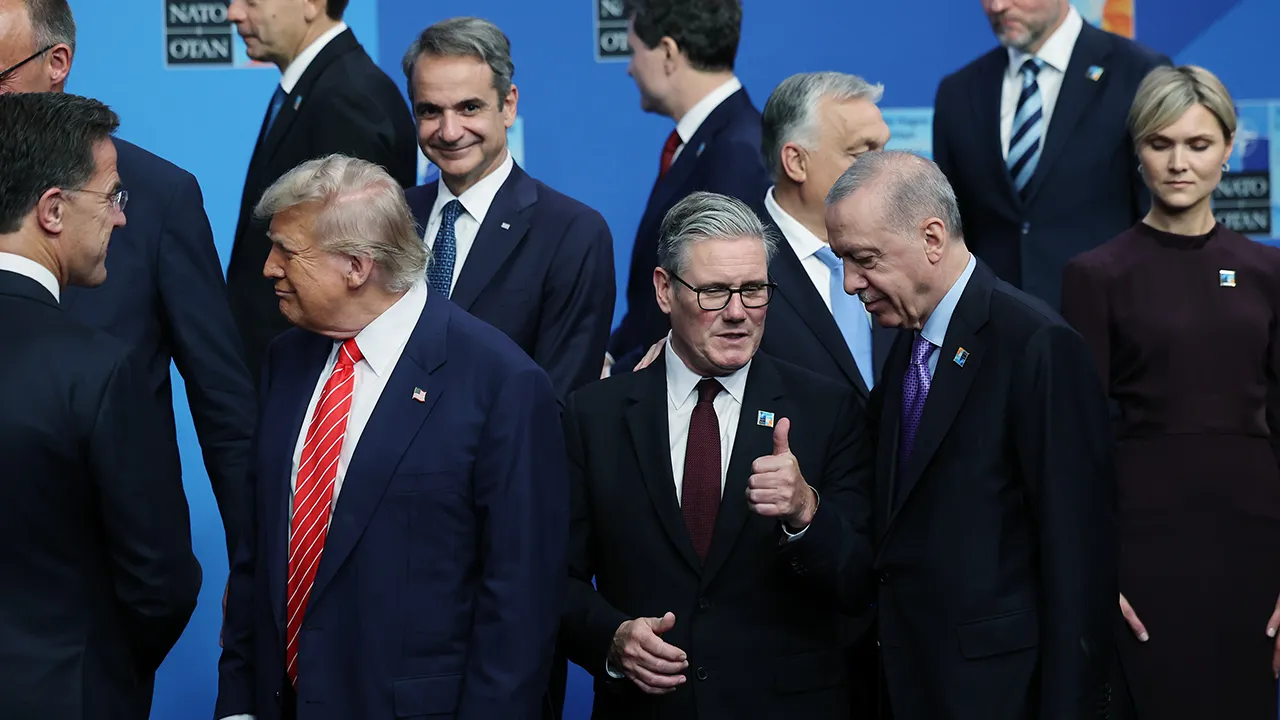
The 2025 NATO Summit took place on June 24-25 in The Hague, the Netherlands. Considered one of the most critical meetings of the post-Cold War alliance, the summit was shaped around global issues such as US President Donald Trump’s approach to NATO in his second term, increasing defense spending and the Ukraine-Russia war. While the summit reflected efforts to strengthen NATO’s unity and deterrence, the Israeli-Iranian tension and the US stance on this issue were influential in the talks. This analysis discusses the expectations from the summit, the actual outcomes, the significance of these outcomes and Turkey’s perspective.
Expectations from the Summit
Ahead of the 2025 NATO Summit, leaders were expected to discuss increasing defense spending to 5% of gross domestic product (GDP), with 3.5% on defense and 1.5% on infrastructure. This target was particularly linked to Trump’s expectation of greater defense contributions from European countries. In a context where some allies, such as Spain, France and the UK, were struggling to meet even the current 2% target, the new target seemed difficult to accept. Support for Ukraine and NATO’s deterrence against Russia were high on the agenda of European leaders. The summit was seen as an opportunity to redefine NATO’s role in European security and test the US commitment to the alliance under Trump.
Decisions taken at the Summit
The messages of NATO Secretary General Mark Rutte, which Trump shared on his social media account before the summit, attracted attention. Rutte stated that European states agreed to allocate 5% of GDP to defense and infrastructure spending, and this development contributed to the positive atmosphere of the summit. The summit, which lasted for about 2.5 hours, ended with decisions that were described as “historic”. The Hague Declaration prioritized areas such as cyber security in the 5% spending target. Although the Declaration affirmed NATO’s “unwavering commitment” to Article 5 (which states that an attack on a member state of the defense alliance will be considered an attack on all member states and a collective response will be taken), the lack of direct reference to the Russia-Ukraine war was attributed to Trump’s sensitivities. Russia was described as a “long-term threat to Euro-Atlantic security”, while the commitment to support Ukraine was reiterated, but no concrete progress was made on membership. The “persistent threat of terrorism” emerged as a second priority at the summit. Spanish Prime Minister Pedro Sánchez’s dissatisfaction with the spending targets drew attention.
Importance of the Summit
The most important outcome of the summit was the 5% defense spending target, demonstrating NATO’s determination to strengthen deterrence against threats such as Russia. NATO’s official statements and posts on the X platform emphasized the alliance’s goal to increase defense industrial cooperation and for allies to provide more than 50% of the total force. However, Trump’s vague statements on Article 5 in the past and the resistance of some allies raised questions about alliance unity. The Summit stressed its determination to continue support for Ukraine and increase Europe’s defense burden.
Global Developments Discussed at the Summit
The summit discussed issues such as Israel-Gaza-Iran, Syria, Ukraine-Russia and China’s global strategies. The leaders called for dialogue on the Israeli-Iranian tension. The Ukraine-Russia war was one of the main agenda items of the summit; although the Hague Declaration affirmed support for Ukraine, the lack of reference to Russian aggression caused controversy. Although China’s current foreign policy was not directly on the agenda, the impact of defense cooperation with Iran and Russia was discussed. The fact that the US, the Alliance’s main actor, sees China as a strategic rival has led NATO to give China more space in its global security policies. Developments in Syria, especially Israel’s operations in the Golan Heights, were among the topics discussed by the leaders.
Turkey’s Priorities and Gains
Turkey attended the 2025 NATO Summit with four priorities: (1) lifting defense trade restrictions, (2) allied solidarity in the fight against terrorism, (3) a mediating role in regional crises, and (4) strengthening the strategic position in NATO through bilateral relations.
The 2025 NATO Summit was an opportunity for Turkey to strengthen its strategic position within the alliance and to emphasize its ambition to assume a regional leadership role. Erdogan’s meeting with Trump is likely to have a positive impact on revitalizing Turkey’s relations with the United States. Turkey’s attempt to take a position in Syria reflects an effort to become an influential ally in NATO’s regional security policies. Erdoğan’s call for dialogue and his intention to be a mediator in the Iran-Israel and Ukraine-Russia crises can be seen in this context.
However, the 5% defense spending target is unlikely to be feasible for Turkey, which is struggling with an economic crisis. In 2024, Turkey allocated 2.09% of its budget to defense spending. However, officials said a gradual increase was possible.
Another priority demand of Turkey was the removal of defense trade-related barriers. In this context, the Hague Declaration stated that “We will work to eliminate defense trade barriers between Allies”. The 2024 Leaders’ Summit also emphasized similar points, but this time it is hoped that more concrete steps will be taken.
Turkey also demanded that the allies take a more active role in the fight against terrorism and take a clear stance against groups like the YPG. “In The Hague, I emphasized that the fight against terrorism can only be achieved with the sincere solidarity of the allies. We ensured that this threat was reflected in the summit declaration,” Erdoğan said at a press conference on the second day of the summit. However, it is known that Western allies, particularly the US, do not view the YPG from a terrorism perspective like Turkey.
At this year’s summit, Turkey has so far achieved symbolic successes. Foremost among these is the decision to hold the 2026 Leaders Summit in Turkey. However, steps such as lifting embargoes on the defense industry and giving Turkey an active role in resolving current regional crises have been limited. Given the differences of opinion with allies in the fight against terrorism, the summit cannot be said to offer Turkey any tangible advantage for the time being.
Conclusion
The 2025 NATO Summit marked an important milestone with the goal of strengthening the alliance’s deterrence by increasing defense spending. However, internal disputes and uncertainties under Trump’s leadership continue to test NATO’s unity. Support for Ukraine, Israeli-Iranian tensions and China’s indirect influence highlighted the summit’s critical role in global security. While Turkey has already made vague and symbolic gains on its priorities, such as defense trade and counterterrorism, economic and strategic challenges are preventing full realization. The outcomes of the summit will shape NATO’s future direction and the global security balance, but the feasibility of spending targets and the unity of the alliance will be critical tests in the years ahead.