The Zangezur Corridor is a strategic passage that has been the focal point of decades of conflict between Azerbaijan, Armenia and regional actors. The changing geopolitical balance after the Second Karabakh War and the TRIPP Peace Summit agreement signed on August 8, 2025 redefined the corridor’s status and revived hopes for peace and economic integration in the South Caucasus. However, the US takeover of the corridor, coupled with the reactions of Russia and Iran, suggests that this agreement holds both opportunities and new tensions. This analysis elaborates on the historical background of the Zangezur Corridor, its strategic importance and its role in the peace process.
The Zangezur Corridor is a 27-43-kilometer passage in the Zangezur region of Azerbaijan (known as Syunik in Armenia), separating the Nakhchivan Autonomous Republic from Azerbaijan and, in other words, severing Turkey’s land connection with Turkestan. This corridor, located on one of the strategic locations connecting the Caspian Sea to Europe via the Caucasus, also plays a critical role in regional dynamics. Azerbaijan and Armenia have been claiming the Zangezur region for decades, and there is a deep disagreement over the status and management of the corridor: In the post-Second Karabakh War paradigm, Azerbaijan demanded unrestricted access to the corridor, while Armenia pursued a policy of protecting its sovereign rights and border controls. This rivalry has made the corridor a source of geopolitical tension.
The roots of the problem go back to the Azerbaijan-Armenia conflicts that began with the collapse of the Soviet Union. In the First Karabakh War of 1988-1994, Armenia seized Nagorno-Karabakh and Zangezur, cutting the Azerbaijan-Nakhchivan connection. The Minsk Group, established in 1992, failed to find a solution to the Karabakh and Zangezur conflict. In the Second Karabakh War in 2020, Azerbaijan retook most of Karabakh and the Russian-brokered ceasefire agreement envisaged opening the Nakhchivan connection, but the definition of a “corridor” was controversial. In 2023, Azerbaijan took full control of Karabakh in a brief operation, but this led to the exodus of 100,000 ethnic Armenians from the region. In the 2024-2025 negotiations, especially with the mediation of the US after the July 2024 Abu Dhabi summit, the transfer of the corridor to the US was agreed, but the reactions of regional actors (Russia, Iran) made the process more complicated.
The strategic importance of the Zangezur Corridor is characterized by its economic and geopolitical dimensions. Economically, it can connect the Caspian Sea to Europe as part of the Central Corridor with a cargo capacity of 15 million tons, and make the Caucasus an energy hub with rail, oil, gas and fiber optic lines. Through the corridor, Armenia can break its isolation and access Kazakh oil and Turkmen gas; geopolitically, it can strengthen the integration of Azerbaijan and Turkey, while the US administration can break Russia’s influence in the South Caucasus. In this context, Iran is worried about being cut off from Armenia, while Russia is concerned about the loss of regional influence. In this respect, while the corridor stands out as an element of peace for security and stability, it will also play a strategic role in global logistics and carries risks due to sovereignty disputes and geopolitical rivalries.
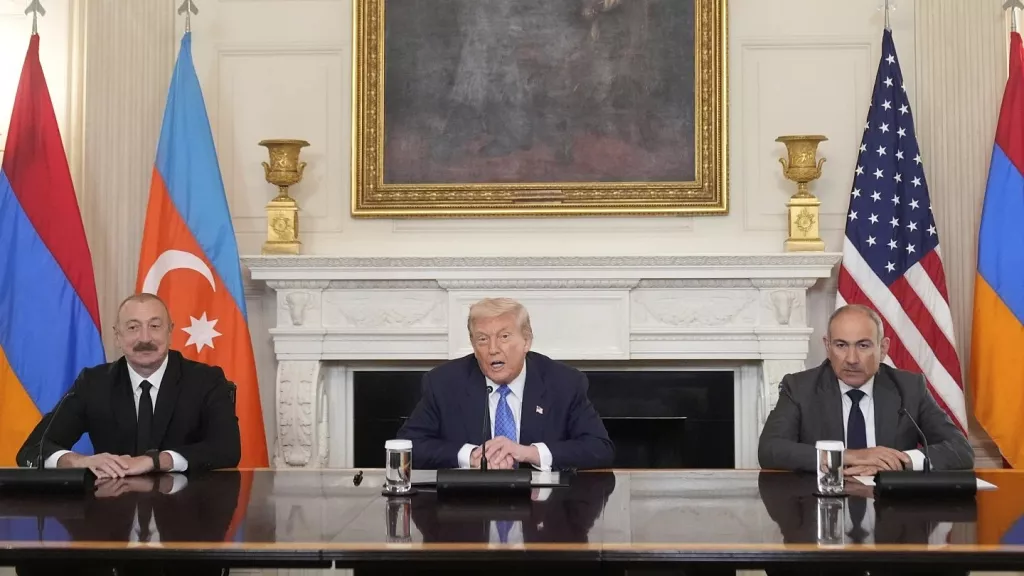
On August 8, 2025, at the White House, hosted by US President Donald Trump, Azerbaijani President Ilham Aliyev and Armenian Prime Minister Nikol Pashinyan signed the “TRIPP Peace Summit” agreement. This is seen as a historic step aimed at ending the nearly 40-year conflict between Azerbaijan and Armenia and aims to strengthen regional peace and economic integration by resolving the status of the Zangezur Corridor. The key elements of the agreement are:
Management of the Zangezur Corridor: Armenia transferred the rights to develop and operate the Zangezur Corridor to the United States for 99 years. The corridor has been named the “Trump International Route for Peace and Prosperity” (TRIPP). The US will transfer these rights to a private consortium (e.g. Exxon Mobil) to develop infrastructure projects such as railways, oil and gas pipelines, fiber optic cables and electricity transmission lines. The corridor would be subject to Armenian law and customs/border controls would remain under Armenian control.
Peace and Diplomatic Relations: The agreement includes a framework declaration that lays the foundation for peace between Azerbaijan and Armenia. The parties committed to respect each other’s sovereignty and territorial integrity, normalize diplomatic relations and cease hostilities. The draft peace agreement agreed in March 2025 is the basis for this declaration.
Bilateral Cooperation with the United States: Both countries signed bilateral agreements to strengthen economic, trade and technological (including artificial intelligence) cooperation with the United States. The United States reinstated defense cooperation by lifting Freedom Support Act restrictions on Azerbaijan (e.g., reviving $100 million in past military assistance).
Dissolution of the Minsk Group: The OSCE Minsk Group (US, Russia, France), established in 1992 to seek a solution to the Nagorno-Karabakh conflict, was officially dissolved, thus ending Russia’s mediation role.
The agreement is expected to boost the region’s economic potential. The corridor will be part of the Central Corridor, connecting the Caspian Sea to Turkey and Europe, with a cargo capacity of 15 million tons. According to the World Bank, it could generate an annual trade volume of $50-100 billion by 2027 and shorten the Europe-Asia transit time by 12-15 days. Armenia aims to break out of economic isolation by gaining access to Kazakh oil and Turkmen gas, while Azerbaijan’s exports could increase by $700 million.
The deal is based on a 100-year lease model proposed by US Ambassador to Turkey Tom Barrack at the Abu Dhabi summit in July 2024, and the framework is said to be inspired by examples of international management such as the Panama Canal. However, its failure to address issues such as the displacement of ethnic Armenians and human rights violations in Karabakh has been criticized, especially by the Armenian diaspora.
Azerbaijan sees Zangezur as critical for its connection to Nakhchivan and Turkey, but Aliyev’s demand for “unimpeded access” has not been fully met by Armenia’s emphasis on sovereignty and the US administration. Still, increased exports, the strengthening of the Central Corridor and defense deals with the United States persuaded Baku to agree to the deal. Strained relations with Russia after the December 2024 plane crash seem to be among the developments that made the deal possible by bringing Azerbaijan closer to the West. On the other hand, Pashinyan alleviated sovereignty concerns by making the corridor subject to Armenian law and seems to have succeeded in breaking isolation with the “Peace Junction” project. While the government, which has been trying to distance itself from Russia for some time, describes the US-involved agreement as an opportunity, the opposition and the diaspora criticize the injustice of the displacement of 100,000 Armenians in Karabakh and consider it a “capitulation”. Security threats for Armenia have not completely passed. Russia-backed social unrest is predicted.
Iran is strongly opposed to the US control of the corridor, which is seen as an attempt to isolate Iran by cutting it off from Armenia and undermining north-south trade. Considering Zangezur as a buffer zone, Tehran sees the deal as a “US and Israeli game” and proposes the idea of the Aras Corridor. In addition, Turkey’s growing influence is another factor that disturbs Iran. Although Iran’s reactions are expected to harden in the coming period, Tehran needs time to reassert its influence in the region after the Israeli-US attacks.
Moscow sees the US takeover of the corridor as a significant loss of influence. In 2020, it was planned that the Russian FSB would control the region, but Armenia’s shift towards the West and Armenia’s absolute defeat in the Karabakh war by 2023 weakened Moscow’s influence both in Armenia and in the South Caucasus. The dissolution of the Minsk Group ended Russia’s diplomatic role. Tensions with Azerbaijan after the plane crash may lead Moscow to escalate its reaction. Despite all these developments, Russia still aims to strengthen its military presence in Armenia.
Turkey sees the deal as a win that strengthens its ties with Azerbaijan and its Central Corridor ambitions. Erdogan has praised the corridor project as a “symbol of regional cooperation” but is wary of a dominant US role. Ankara’s support for the deal is bolstered by Russia’s waning influence and the prospect of normalization with Armenia.
US President Trump is presenting the deal as a geopolitical victory over both Russia and China and an achievement for global peace. Washington will seek economic leadership in the region with US firms such as Exxon Mobil, while strengthening defense ties with Azerbaijan and trade ties with Armenia. However, criticism of Karabakh by the Armenian diaspora, which is also influential in the United States, and Russian-Iranian reactions could complicate the implementation of the agreement.
Overall, the agreement takes a bold step in the Azerbaijan-Armenia peace process by resolving the Zangezur Corridor issue under US leadership, but it is not without its limitations. Economically, the corridor’s potential for $50-100 billion in trade volume and the opportunity for Armenia to break out of isolation are promising; however, the exodus of ethnic Armenians from Karabakh and the unresolved human rights issues increase resistance from the Armenian diaspora and opposition and undermine the social legitimacy of peace. Geopolitically, the ground the US claims to have gained, first against Russia and then against China, could be shaken by Iranian and Moscow’s harsh reactions; Iran’s Aras Corridor proposal and Russia’s attempt to strengthen its military presence in Armenia make the risk of intervention more pronounced. While the agreement offers strategic gains for Azerbaijan and Turkey, Armenia’s sovereignty concerns and competition from regional actors threaten its viability. For now, the future of the corridor depends on the parties’ willingness to honor their commitments and the ability of the United States to balance the Russia-Iran axis; otherwise, the corridor could spark new tensions.
Image Source: Euronews, “Azerbaijan-Armenia Peace Agreement and the Zangezur Corridor”, August 8, 2025