The war in the Middle East, which has been affecting the entire region for nearly 40 days, seems to have stopped for the time being with the ceasefire announced. However, it may be misleading to read this development as the beginning of a lasting peace. The absence of a comprehensive and binding consensus framework indicates that the current situation points to a strategic break between the parties as a result of their failure to achieve their goals, rather than a peace agreement.
The war between the US, Israel and Iran, which has been raging for nearly 40 days and has affected the entire region, has been halted for the time being with a ceasefire brokered by Pakistan. However, it would be misleading to read this development as a peace agreement. The current situation points to a strategic pause forced by the failure of the parties to achieve their goals.
The absence of a comprehensive and binding reconciliation framework makes it clear that this is a temporary pause rather than a lasting peace. The ceasefire therefore marks only a postponement of the war, not its end. More importantly, there are strong indications that both Iran and Israel are using this period to prepare for a new wave of conflict. Both sides are looking for an opportunity to recover their eroded capacities on the ground, strengthen their military and political positions, and reactivate under more favorable conditions.
Although the current ceasefire presents an appearance of calm on the surface, it would not be wrong to say that an intensive preparatory process has begun in the background. The fact that the parties do not want to engage in a direct conflict in the short term does not mean that this possibility has disappeared in the long term. On the contrary, such ceasefires have often been a harbinger of a more extensive and destructive next phase.
In this process, Turkey has also made intensive diplomatic efforts for the establishment of peace. However, Pakistan’s prominence in mediation is closely linked not only to its regional position but also to its capacity to establish contacts with different actors. However, the fact that no concrete results have emerged from the recent talks in Pakistan also shows how fragile the process is. This shows that the process is directly related to not only regional but also global power balances. The fact that in addition to Turkey and Pakistan, Saudi Arabia and Oman are also trying to contribute to the process reveals the common concern of regional actors to prevent the conflict from spiraling out of control.
The targeting of military bases, critical infrastructure and industrial facilities in the later stages of the war suggested that the conflict could enter a more dangerous phase. In particular, the targeting of energy facilities and desalination infrastructure put the region at risk of a major humanitarian crisis and migration waves. In this respect, the ceasefire is not only a military pause, but also a postponement of a potential catastrophe.
The Iranian regime has survived despite serious damage. This has been made possible not only by military capacity but also by social solidarity. However, this process also brings with it the possibility of a transformation for Iran. The regime can be expected to adopt a more cautious and flexible approach.
For the US, the most critical aspect of this ceasefire is how it will be explained to the domestic public opinion. The Donald Trump administration in particular seems to be trying to make a controlled success story out of this process. However, at a more strategic level, Washington’s main objective is to buy time and focus on other areas of global competition.
The picture is clear: this is not peace, but a controlled pause. The fact that Iran and Israel see this process as a window of opportunity for a new conflict should not be ignored. The current ceasefire may therefore be a quiet preparatory phase before a bigger showdown rather than a lasting solution.
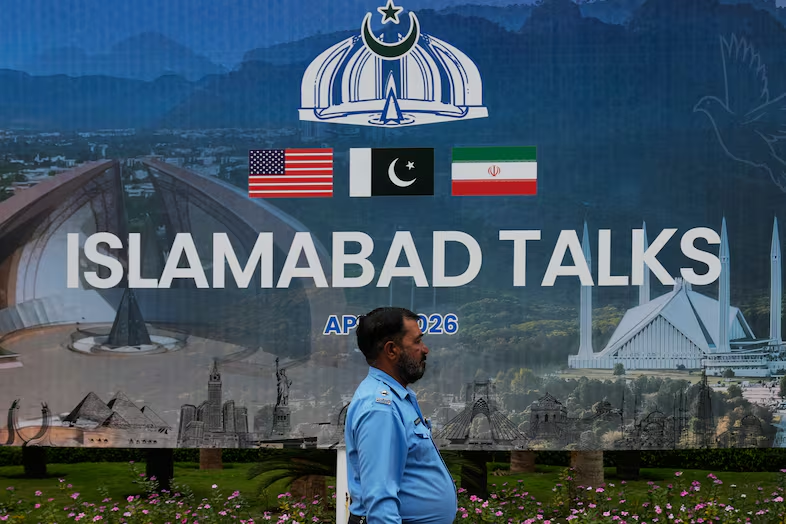
Image source: Anjum Naveed, “A police officer walks past a billboard regarding the United States and Iran negotiations, outside a media facilitation center in Islamabad, Pakistan, Saturday, April 11, 2026,” OPB, 11 April 2026.