The current course of the US-Iran conflict confronts Washington with decisions that could have grave consequences not only militarily but also economically and politically. The possibility of a ground operation is therefore a strategic turning point that represents much more than a tactical option.
As the conflict between the United States and Iran enters its fourth week, the debate in Washington seems to have moved beyond the classic question of whether to intervene. The focus of the debate is now on the extent and conditions under which the option of a ground operation can be considered.
While assessments that the effectiveness of air and naval operations has reached certain limits are gaining strength, the Pentagon’s preparations in the region indicate that tougher military options are not excluded. However, it is not enough to read this military debate solely in terms of developments on the ground. Increasing pressures on the US economy, the high spending burden and the fragility of global markets may provide a backdrop for the administration’s moves that are expected to produce faster and more significant results.
At this point, domestic politics also stands out as a determining factor. Trump is facing increasing domestic political pressures, fluctuations in public support, and his decision-making process is progressing within an increasingly narrow timeframe and room for maneuver. Historically, it is not uncommon for foreign policy moves to be used to balance domestic political equations in such periods.
Therefore, the emerging picture points to a critical moment of decision where economic, political and strategic pressures intersect, rather than a process that can be explained solely by military necessities.
Three Scenarios, Common Reality: High Risk Options
It can be argued that Washington has three main ground operation scenarios in front of it. However, none of these options offers a low-risk solution.
The seizure of Hark Island stands out as a direct means of economic pressure targeting Iran’s oil exports. While at first glance it may seem like a move that could produce quick results, the island’s proximity to the Iranian mainland makes it a target that could be under constant fire. Moreover, Iran’s capacity to reduce the strategic value of the island by cutting off its energy flow should not be ignored. This could risk turning a short-term military gain into a long-term liability.
An operation along the shoreline of the Strait of Hormuz offers a more concrete objective: to re-secure maritime trade. However, it is well known that such operations tend to be expansive in nature. Controlling the coastline alone may not be enough; it must also be sustainably held. This means more forces, longer deployments and deeper engagement. This is why there is a high probability that an operation that initially appears limited may turn into an expansion that is difficult to control over time.
The most critical and salient scenario is the seizure or neutralization of the enriched uranium stockpile in Isfahan. Iran’s stockpile of highly enriched uranium represents a critical threshold for nuclear weapons capability. Controlling or neutralizing this material would be a development that could seriously affect the strategic balance.
However, the risks of this scenario are equally high. Uncertainty about the exact location of the target and the fact that the facilities are located in underground structures make such an operation extremely complex. Such an operation would require a wide-ranging response, involving not only special forces but also engineering and nuclear expertise. Moreover, conducting the operation in the interior of Iran, in difficult geographical conditions and over long logistical lines, may make the troops on the ground vulnerable.
The Isfahan scenario therefore potentially offers the greatest strategic gain, but also the highest cost of failure.
Economy, Politics and War: Profit or Stalemate?
It would be insufficient to read the current picture only in terms of military plans. The US’s increasing budget burden, rising operational costs and general economic pressures directly affect the decision-making process. The pace of spending reaching billions of dollars per day makes the sustainability of this process more questionable.
Domestically, the picture is more complex. It is understood that public support for the ground operation is limited and allied support remains relatively weak. Under these circumstances, the Trump administration seems to be caught between the need to appear strong and the political cost of entering a protracted war.
In this framework, the idea of military action can be considered not only as a security strategy, but also as a means of alleviating economic pressures and creating room for maneuver in domestic politics. However, it is clear that such a choice entails serious risks.
Because the reality on the ground does not change: Iran’s mountainous geography, “mosaic defense” approach and dispersed resistance capacity create an environment in which even a limited operation can rapidly expand.
Ultimately, the fundamental question for Washington is simple but weighty: can the strategic gain be balanced against the risk of escalation, prolonged engagement and economic cost?
Historical experience shows that such interventions often go beyond the initial objectives and can have more severe consequences than anticipated.
Today’s decision should be seen not only as a military choice, but also as a multi-layered strategic threshold that has the potential to be a decisive turning point for the United States’ economic resilience, political stability and global role.
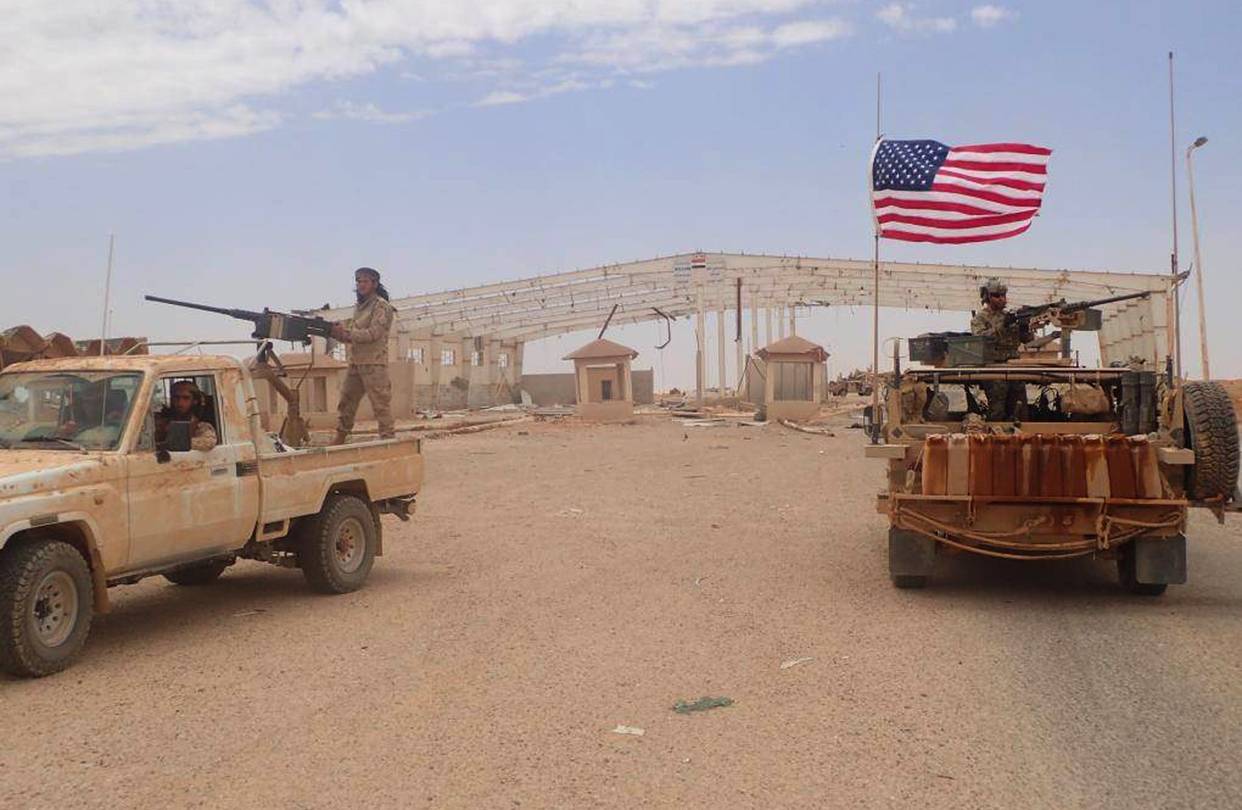
Image source: The Wall Street Journal, “Syria’s Newest Flashpoint Is Bringing U.S. and Iran Face to Face,” June 15, 2017.